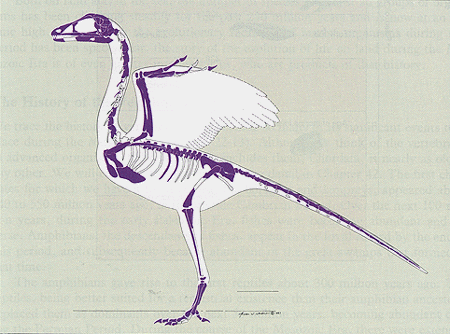
Somewhat of a spiritual sequel to my Protoavis article I do want to discuss another idea that Chatterjee had purposed in the second edition of his book The Rise of Birds: 225 Million Years of Evolution. On the chapter of the origin of birds where he reviews and discusses on the relationships among theropods, Chatterjee took note that some taxa that have usually been classified as deinonychosaurs (the group that includes the two “raptor” families Dromaeosauridae and Troodontidae) might be closer to the clade Avialae (the stem branch that leads up to our modern crowned birds). In particular a new family he has created for a particular bunch of paravian dinosaurs that are seen proof for the naturalist William Beebe's "four-winged" bird Tetrapteryx.
In the past few years large systematic analyses have shown this complex relationship of these two paravian clades. In particular there is the notion that Troodontidae and two of the subclades of Dromaeosauridae - Unenlagiinae and Microraptoria - might be closer to the ancestry of birds than they are related to Eudromaeosauria (Agnolin & Novas, 2013; Godefroit et. al, 2013 and Lefèvre et. al, 2014). Thus “Averaptora” is the clade defined as paravians closer to Passer but not to Deinonychus (Agnolin & Novas, 2013), thus consists of Troodontidae + ((Microraptoria + (Unenlagiinae + Avialae)). This makes Deinonychosauria paraphyletic.
This also has huge implications on a group of paravians that have been somewhat problematic. I am of course talking about the genera Xiaotingia, Aurornis, Anchiornis, and Eosinopteryx. These paravian genera have been placed all over the tree, with some commonly suggesting they are basal troodonts (Godefroit et. al, 2013; Brusatte et. al, 2014), archaeopterygids (Xu et. al, 2011), or basal avialans (Lefèvre et. al, 2014). Despite these different placements for these paravians there is one thing they all had in common - they always come out as a monophyletic clade. True there are some papers that have disputed this, whether that the genera are really a mixbag of basal paravians of different ancestry (Senter et. al, 2012) or a paraphyletic grade in respect to the rest of Avialae (Lefèvre et. al, 2014), but majority of the systematic work has support a monophyletic family of sorts otherwise.
 |
| Reconstruction of the conceptual Tetrapteryx by William Beebe. |
This is where Chatterjee comes in. He created the family Tetrapterygidae (in honor of good ol' Tetrapteryx) where he used the character trait of a biplane bauplan (basically long feathers on the arms and legs) as a synapomorphy (Chatterjee, 2015). This meant that Xiaotingia, Aurornis, Anchiornis, and Microraptor are members of this family and as a whole are the sister taxon to Avialae (Chatterjee, 2015). However there is a problem with this as he is only using one character. Most other work uses at least 1,000 characters! This affects the overall phylogeny of Paraves. What I find peculiar is Chatterjee seems to be completely unaware that Archaeopteryx being biplane bauplan animal (Foth, 2014) and not the “monoplane bauplan” Chatterjee claimed it was (Chatterjee, 2015), and the fact he only place Microraptor in Tetrapterygidae but not other microraptorans (Sinornithosaurus was placed in Dromaeosauridae) despite Microraptora being an otherwise a widely supported monophyletic group (particularly them being “four-winged” dinosaurs; e.g Gong et. al, 2014 and Han et. al, 2014). In addition he places Eosinopteryx as a basal paravian and Deinonychosauria (to some extent) as a monophyletic group (Chatterjee, 2015), which is perhaps not the case.
As you can tell, Chatterjee needed to add more characters and more taxon which he was in lacking of. If he would have done otherwise, he might have come to more similar results with other, more comprehensive systematic work (such the concept of Averaptora versus Deinonychosauria). Not to mention that just because Eosinopteryx lacks the feathering does not mean it is not related to these other “four-winged” dinosaurs. Based on modern families of birds and mammals, there can be quite an extraordinary variance among the family’s taxa (I am thinking of Phasantidae and Anatidae especially!) so it would not be surprising if one of these "four-winged" dinosaurs lacks any feathering on their legs. That is why some paleontologists might consider Chatterjee’s work as cringe worthy for he seems to not have an open mind or a pragmatist concerning the subject and the characters he uses is not sufficient. Lastly, why name a family of animals where there is no such genus as Tetrapteryx to begin with? You need the type genus as the basis for the family name. This automatically makes this family invalid according to the Article 29.1 of the ICZN! It should be "Anchiornithidae" instead!
Does this make "Anchiornithidae" invalid? Not necessarily, but perhaps only of Xiaotingia, Aurornis, Anchiornis, and Eosinopteryx. Microraptoria as a whole may be included as well, but some earlier work suggest otherwise for the time being. It would be interesting to see what other workers have to say about this, as well as testing out the placement of these stem-birds among Paraves. I would not be surprise if the family turns out to be a basal Avialae family (perhaps a sister taxon to Archaeopteryx perhaps? a junior synonym of Archaeopterygidae? or if "Anchiornithidae" is another family in Archaeopterygiformes?). But as mention earlier the evolution of flight and feathers is a complicated story (Godefroit et. al, 2013), and is possible that "Anchiornithidae" are paraphyletic in respect to the rest of Avialae. But these are just mere speculations and only time will tell. We need a more comprehensive data and multiple characters and not the old fashion using a single trait that Chatterjee had used.
Further Reading
The awesome Matthew Martyniuk on his blog DinoGoss recently discussed this as well. He more or less said the same thing as I said, although he made an interesting comment I was not aware of. His post can be read here.
References
As you can tell, Chatterjee needed to add more characters and more taxon which he was in lacking of. If he would have done otherwise, he might have come to more similar results with other, more comprehensive systematic work (such the concept of Averaptora versus Deinonychosauria). Not to mention that just because Eosinopteryx lacks the feathering does not mean it is not related to these other “four-winged” dinosaurs. Based on modern families of birds and mammals, there can be quite an extraordinary variance among the family’s taxa (I am thinking of Phasantidae and Anatidae especially!) so it would not be surprising if one of these "four-winged" dinosaurs lacks any feathering on their legs. That is why some paleontologists might consider Chatterjee’s work as cringe worthy for he seems to not have an open mind or a pragmatist concerning the subject and the characters he uses is not sufficient. Lastly, why name a family of animals where there is no such genus as Tetrapteryx to begin with? You need the type genus as the basis for the family name. This automatically makes this family invalid according to the Article 29.1 of the ICZN! It should be "Anchiornithidae" instead!
Does this make "Anchiornithidae" invalid? Not necessarily, but perhaps only of Xiaotingia, Aurornis, Anchiornis, and Eosinopteryx. Microraptoria as a whole may be included as well, but some earlier work suggest otherwise for the time being. It would be interesting to see what other workers have to say about this, as well as testing out the placement of these stem-birds among Paraves. I would not be surprise if the family turns out to be a basal Avialae family (perhaps a sister taxon to Archaeopteryx perhaps? a junior synonym of Archaeopterygidae? or if "Anchiornithidae" is another family in Archaeopterygiformes?). But as mention earlier the evolution of flight and feathers is a complicated story (Godefroit et. al, 2013), and is possible that "Anchiornithidae" are paraphyletic in respect to the rest of Avialae. But these are just mere speculations and only time will tell. We need a more comprehensive data and multiple characters and not the old fashion using a single trait that Chatterjee had used.
Further Reading
The awesome Matthew Martyniuk on his blog DinoGoss recently discussed this as well. He more or less said the same thing as I said, although he made an interesting comment I was not aware of. His post can be read here.
References
- Agnolin, F., & Novas, F. E. (2013). Avian Ancestors: A Review of the Phylogenetic Relationships of the Theropods Unenlagiidae, Microraptoria, Anchiornis and Scansoriopterygidae. Springer Science & Business Media.
- Brusatte, S. L., Lloyd, G. T., Wang, S. C., & Norell, M. A. (2014). Gradual assembly of avian body plan culminated in rapid rates of evolution across the dinosaur-bird transition. Current Biology, 24(20), 2386-2392.
- Chatterjee, S. (2015). The Rise of Birds: 225 million Years of Evolution. Johns Hopkins University Press, 45-48.
- Foth, C., Tischlinger, H., & Rauhut, O. W. (2014). New specimen of Archaeopteryx provides insights into the evolution of pennaceous feathers. Nature, 511(7507), 79-82.
- Han, G., Chiappe, L. M., Ji, S. A., Habib, M., Turner, A. H., Chinsamy, A., ... & Han, L. (2014). A new raptorial dinosaur with exceptionally long feathering provides insights into dromaeosaurid flight performance. Nature communications, 5.
- Godefroit, P., Demuynck, H., Dyke, G., Hu, D., Escuillié, F., & Claeys, P. (2013). Reduced plumage and flight ability of a new Jurassic paravian theropod from China. Nature communications, 4, 1394.
- Godefroit, P., Cau, A., Dong-Yu, H., Escuillié, F., Wenhao, W., & Dyke, G. (2013). A Jurassic avialan dinosaur from China resolves the early phylogenetic history of birds. Nature, 498(7454), 359-362.
- Gong, E. P., Martin, L. D., Burnham, D. A., Falk, A. R., & Hou, L. H. (2012). A new species of Microraptor from the Jehol Biota of northeastern China. Palaeoworld, 21(2), 81-91.
- Lefèvre, U., Hu, D., Escuillié, F., Dyke, G., & Godefroit, P. (2014). A new long‐tailed basal bird from the Lower Cretaceous of north‐eastern China. Biological Journal of the Linnean Society, 113(3), 790-804.
- Senter, P., Kirkland, J. I., DeBlieux, D. D., Madsen, S., & Toth, N. (2012). New dromaeosaurids (Dinosauria: Theropoda) from the Lower Cretaceous of Utah, and the evolution of the dromaeosaurid tail. PloS one, 7(5), e36790.
- Xu, X., You, H., Du, K., & Han, F. (2011). An Archaeopteryx-like theropod from China and the origin of Avialae. Nature, 475(7357), 465-470.